Archive
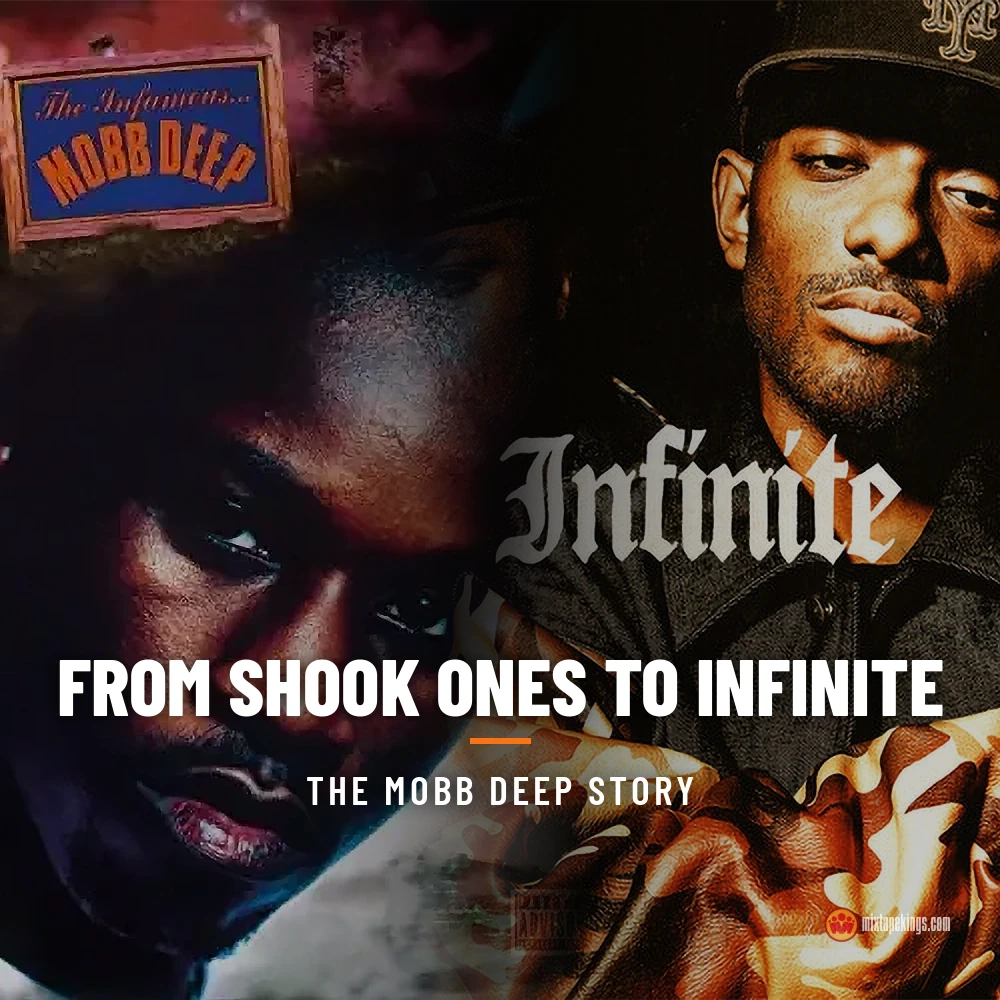
From Shook Ones to Infinite: The Mobb Deep Story
By Diony C.
•July 13, 2026
•11 min read
Prodigy and Havoc grew up in Queens, made The Infamous in a Queensbridge bedroom, got dissed by Tupac, dropped by two labels, signed to G-Unit, and still outlasted every era they passed through. The full arc of Mobb Deep.
Prodigy and Havoc met in Manhattan at the High School of Art and Design, a school that produced Calvin Klein, Marc Jacobs, and Fab Five Freddy. Havoc had moved to Queensbridge from Hempstead when he was six years old. Prodigy was born in Hempstead on Long Island and moved to LeFrak City in Queens as a kid. They were teenagers who loved hip-hop and found each other in the one place that brought them together.
They called themselves Poetical Prophets first. Then Mobb Deep, a name that reflected their tight-knit circle of friends from the bridge. In 1991, The Source ran them in the Unsigned Hype column. By 1992 they had a deal with 4th and B’way Records. They were still teenagers.
What came next is one of the most instructive stories in the history of rap.
Juvenile Hell and the Lesson
Their debut album, Juvenile Hell, dropped in 1993. It had production from DJ Premier and Large Professor, two of the most respected producers in the game. It went largely unnoticed. At a record store event for the album, the staff played Illmatic instead of Mobb Deep’s music during a lull. Nasir Jones had not even released that album yet. The store was playing the advance.
Havoc and Prodigy left embarrassed and went back to Queensbridge. They did not quit. They went back to the bedroom with the MPC-60, the Ensoniq keyboard, and the records Havoc’s father used to spin in the house. They fished around for a new sound. They found it in a piano melody from “Jessica,” a track on Herbie Hancock’s Fat Albert Rotunda, pitched down until it sounded less like music and more like a warning.
They shopped a new deal. Russell Simmons at Def Jam passed because they cursed too much. Sean Combs was about to launch Bad Boy and was interested. They ended up with Loud Records instead. It was the right call.
The Infamous
April 25, 1995. The Infamous arrived and nothing sounded like it.
Havoc produced almost everything on the album in his Queensbridge bedroom. The beats were dark, sample-based, and minor-key in a way that felt less like aesthetic choice and more like honest documentation. Prodigy rapped about the specific reality of the Queensbridge Houses with a precision that felt almost journalistic, except the journalism was delivered with a cold detachment that made it more unsettling than any outrage could have been.
Shook Ones Part II became one of the defining records of East Coast rap. The stuttering piano sample, the dead-eyed lyrical delivery, the hook that had every kid in New York memorizing it on the way to school. Survival of the Fittest. Temperature’s Rising. Eye for an Eye with Nas and Raekwon. Every track built the same world from a different angle.
The album title came from a friend named Yamit, a Golden Gloves boxer who lived on Havoc’s block. He had “The Most Infamous” tattooed on his bicep. They were already Mobb Deep but he had named them something better. The Notorious B.I.G. heard early versions and gave them advice on structuring the album. Q-Tip contributed to the production and mixing. The Queensbridge and Brooklyn connection running through the record was real.
The Infamous cracked the Top 20 of the Billboard 200. It informed crews that came years later: G-Unit, Dipset, Griselda. Havoc’s production template, the minor key soul samples over hard drums with space for the voice to breathe, became one of the most imitated sounds in New York rap history. The Shook Ones beat would appear years later in the film 8 Mile, under Eminem’s most famous freestyle.
Hell on Earth, Murda Muzik, and the Tupac Situation
Hell on Earth followed in 1996 and went Top Ten. Murda Muzik in 1999 debuted at number three on the Billboard 200 despite being heavily bootlegged before the release date, which forced Loud Records to move the street date up. It went platinum. Three consecutive albums that went higher commercially while the artistic credibility held.
Through all of it, Tupac Shakur dissed them. He put them in Hit Em Up. He put them in other records. Havoc’s response when asked about it later was revealing: he said he didn’t even know what the beef was about, that they had never crossed paths with Shakur before his death, that from a long distance he was a fan. He added that when Tupac dissed them, his first thought was about record sales. That clarity is part of what made Mobb Deep who they were.
The Label Years
After Murda Muzik, the road got harder.
Infamy in 2001 showed a group trying to reach a wider audience. Hey Luv was the first Mobb Deep song that mentioned love, the first that flirted with R&B crossover. It got airplay. The critics were mixed. Then Loud Records went out of business, leaving Prodigy and Havoc without a deal.
The years between 2002 and 2005 were their most uncertain. They released Free Agents: The Murda Mix Tape on Landspeed in 2003, the title a direct statement about their situation. They went to Jive Records for Amerikaz Nightmare in 2004. The album went Top Ten but the label dropped them.
Then came the announcement that surprised everyone: 50 Cent had signed Mobb Deep to G-Unit Records. For fans of The Infamous this was difficult to process. The Queensbridge griminess that defined their catalog did not obviously fit the commercial infrastructure 50 Cent was building. Blood Money came out in 2006 and the reception was cool.
The G-Unit era ended. Prodigy served a prison sentence on a weapons charge from 2008 to 2011. They fell out as partners. They came back together. The pattern repeated.
What the Labels Never Owned
Through all of it, the music that mattered was the music they made on their own terms.
Prodigy’s Return of the Mac with The Alchemist in 2007 is considered a classic. Albert Einstein with Alchemist in 2013 is nearly as good. H.N.I.C., his first solo album, captured a different side of who he was. Havoc produced for Eminem, for Kanye West, for a generation of artists who grew up on The Infamous. The core creative engine never stopped.
In June 2017, while hospitalized in Las Vegas for complications of sickle cell anemia, an illness that had affected him since birth, Prodigy died from accidental choking. He was 42. Three years after his death, The Infamous reached platinum status. The audience kept growing after he was gone.
Havoc did not stop. He assembled Infinite, released October 10, 2025, the final Mobb Deep album, built on previously unissued Prodigy vocals and new Havoc production. The Alchemist helped put it together. Nas, Clipse, Raekwon, Ghostface Killah, Big Noyd, and Jorja Smith appeared on it. The album proved two things: that Havoc’s production still sounds like nothing else, and that Prodigy left enough behind to have the last word.
In early 2026, Havoc released a series of remastered sessions from the 1994 to 1997 era. The Queensbridge Art Initiative unveiled a permanent mural of Prodigy and Havoc overlooking the East River, commemorating the 31st anniversary of The Infamous.
Thirty years of making music on their terms and the terms of whoever would sign them. The label years were real. But the music that outlasted the labels was made in a Queensbridge bedroom with a drum machine and records borrowed from a father who used to DJ in the house.
That is what is still playing.
”Shook Ones, Pt. II.” The Herbie Hancock piano pitched into a warning, Havoc’s bedroom drums, and Prodigy delivering Queensbridge with no heat in his voice. The record every era since has had to answer to.
From the Catalog
Every Mobb Deep title in the shop is documented below. The arc runs from 1993 to 2025. Every record earned its place.
In the Store
Juvenile Hell (CD)
$17.99
The 1993 debut. DJ Premier and Large Professor on the boards. The record nobody heard that made The Infamous possible.
Shop Juvenile Hell CDThe Infamous (CD)
$9.99
April 25, 1995. The album that defined East Coast hardcore rap for a generation. Shook Ones Pt. II. Survival of the Fittest. The entry point for every Mobb Deep collection.
Shop The Infamous CDThe Infamous (2xLP)
$29.98
The 2026 Sony Legacy reissue on 140g vinyl. The definitive physical format for the definitive Mobb Deep album.
Shop The Infamous 2xLPHell on Earth (CD)
$9.99
November 1996. The follow-up that went Top Ten and proved The Infamous was not a fluke. Darker production, sharper writing, the full Queensbridge sound at its peak.
Shop Hell on Earth CDInfinite (CD)
$13.98
October 2025. The final Mobb Deep album. Havoc’s production, Prodigy’s previously unissued vocals, The Alchemist assisting. Nas, Clipse, Raekwon, and Ghostface all appeared. The last word from Queensbridge.
Shop Infinite CDInfinite (2xLP, White Vinyl)
$29.98
The Mass Appeal white vinyl pressing of the final album. Limited run. The physical format for the record that closed the Mobb Deep story.
Shop Infinite 2xLP White VinylSubscribe to the What’s Good newsletter for more from the archive.
Get Early Access